 PanSpan
Pastry Rolling Mat
Which pastry rolling mat will keep dough off my counter and make it easier to roll pie crusts, bread and other sticky dough?
For most home bakers, I’d choose the QUELLANCE: its 28-by-20-inch surface gives you room to roll, knead and shape, with guides and a non-slip base. If getting a pie crust to the right diameter is your priority, the smaller OXO is the clearest choice because it has dough-diameter outlines. The other mats trade working area and construction details, so the best fit depends on whether you value a large surface, precise pie guides or a smaller mat that’s easier to manage.

#1 · QUELLANCE
Non-slip Silicone Pastry Baking Mat 28''x 20'' Extra Large for Pastry Bread | Non-Stick Mat with Measurements, Counter Dough Rolling Oven Liner Fondant Pie Crust Sourdough Supplies Household Baking Gift
Choose this if you want the most room for bread dough, pizza or several holiday baking jobs on one mat. It measures 28 by 20 inches, has inch and centimeter guides, and is designed to grip the counter while you roll.
#2 · Folksy Super Kitchen
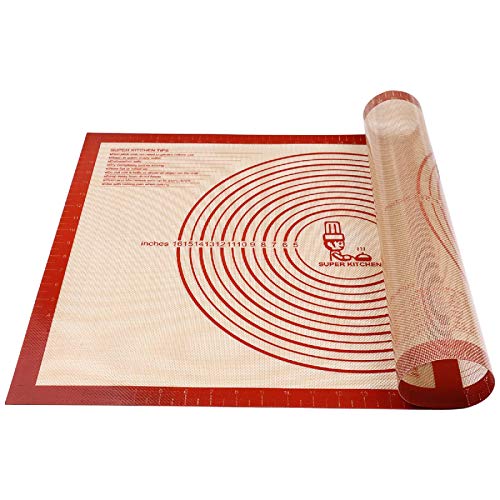
Non-slip Silicone Pastry Mat Extra Large Measurements 28''x 20'' Baking Mat | Silicone Baking Mat Counter Dough Rolling Oven Liner Fondant / Pie Crust Sourdough Bread Supplies - Folksy Super Kitchen Red
This is another strong large-mat choice if you want a roomy 28-by-20-inch surface and a non-slip back. Its 0.7 mm thickness is intended to resist wrinkling during use, and it can also serve as an oven liner within its stated temperature range.

#3 · OXO
OXO Good Grips Non-Slip Silicone Pastry Mat with Built-In Measurements | Baking Essentials, Measurement Guides, Grips and Protects Counter, Ideal for Rolling Dough and Baking, Baking Conversions
Take the OXO if pie crust sizing matters more than having the biggest work surface. Its dough-diameter outlines, ruler border and readable conversion and ingredient-substitution guides make it the most useful option for following measurements at a glance.

#4 · DANIA & DEAN
DANIA & DEAN 26"x16" Extra Thick Silicone Baking Mat for Pastry and Bread | Non-Slip & Non-Stick Mat with Measurements, for Pizza, Pie Crust, Dough Rolling, Pasta & Sourdough, Reusable Counter Sheet
Choose this if you want a 26-by-16-inch mat with 0.7 mm thickness and a fiberglass-reinforced construction. It’s a practical middle-size workspace for dough rolling and kneading, with inch and centimeter guides.

#5 · Dwavele
24" x 16" Silicone Pastry Mat with Measurement Guides | Extra Thick Pastry Rolling & Sourdough Mat Baking Supplies for Making Pizza, Pie, Cookies and Bread
This is the compact pick for a smaller counter or a baker who wants measurement, proportion and temperature guides in one place. At 24 by 16 inches, it gives up working area but still has a 0.7 mm thickness and a non-slip base.
Do you need the biggest mat, or clearer pie-crust sizing?
For a generous area to knead bread or roll pizza dough, take the QUELLANCE or Folksy; both are 28 by 20 inches. For pie crusts that need to fit a particular pan, the OXO’s dough-diameter outlines are more useful than general measurement guides. I’d give up some space for the OXO if those circles are the feature you’ll reach for every pie day.
Does a thicker mat matter for rolling dough?
The QUELLANCE, Folksy, DANIA & DEAN and Dwavele mats each state a thickness of 0.7 mm. That gives you a consistent starting point among those four, but thickness alone won’t stop every mat from shifting: a clean, dry counter and a fully flattened mat matter too. For heavier kneading, choose Dwavele, which is specifically described as resisting tearing under heavy kneading; choose QUELLANCE instead if you want the larger 28-by-20-inch workspace.
Should you choose fiberglass reinforcement?
The DANIA & DEAN is the fiberglass-reinforced option; choose it if that construction is a priority, or choose another mat for its size or guides instead. Reinforcement does not make it cut-proof, so use a bench scraper gently and keep knives and pizza wheels off every mat.
Will you use the mat in the oven as well as on the counter?
The Folksy gives an oven-use range of -30°F to 470°F, and the DANIA & DEAN gives -45°F to 450°F. If oven use is part of the plan, I’d choose between those two and stay within the stated range. For the other mats, treat them as countertop work surfaces unless you have a reliable temperature limit for that specific mat.
How they compare
Which one is yours
QUELLANCE: You want the largest work area, measurement guides and a mat described as easy to wash and roll or fold for storage.
Folksy Super Kitchen: You want a large, non-slip mat and value its stated oven temperature range as well as countertop use.
OXO: You mostly roll pie crusts and want visible dough-diameter outlines, a ruler border and baking-reference guides.
DANIA & DEAN: You prefer a mid-size, fiberglass-reinforced mat and want an explicitly stated oven-use range.
Dwavele: You want a smaller work surface with measurement, proportion and temperature guides, especially for dough tasks on a tighter counter.
You will also want
A soft dish cloth is handy for wiping flour and dough residue from the mat after baking, then drying it before storage.

Homaxy 100% Cotton Waffle Weave Kitchen Dish Cloths 6-Pack, Dark Grey | 12 x 12 Inches, Ultra Soft Absorbent Dish Towels, Quick Drying Dish Rags with Hanging Loop
Use these cotton dish cloths to wipe down the counter after floury baking.
Questions buyers ask
Do you need flour when rolling pie dough on a silicone mat?
Usually, start with little or no flour: a clean silicone surface helps dough release without coating the counter. If the dough is very soft or sticky, dust it lightly and add more only as needed; too much flour can toughen pastry.
Will dough stick to a silicone pastry mat?
Silicone mats are designed to provide a non-stick work surface, but very warm or wet dough can still cling. Chill pastry when it becomes soft, use a light dusting of flour if needed, and lift the dough gently rather than scraping aggressively.
Are thicker silicone mats better for kneading bread?
A thicker mat can feel more substantial under pressure, but grip and a flat, clean counter matter just as much. Dwavele specifically says its 0.7 mm mat resists tearing during heavy kneading; choose it if that is your main concern, or QUELLANCE if you want the larger 28-by-20-inch workspace.
Do printed measurements wash off silicone pastry mats?
Carefully wash the mat with a soft cloth or sponge and avoid abrasive scrubbing or sharp tools across the print. That’s the sensible way to protect the guides, though print durability depends on the individual mat.
Can a pastry rolling mat go in the oven?
Only use a mat in the oven when its temperature limit is stated and stay within it. The Folksy gives a range of -30°F to 470°F, and the DANIA & DEAN gives -45°F to 450°F; don’t assume the same limits for the other mats.
How should you store a silicone dough mat?
Wash and dry it fully, then roll it loosely or store it flat if you have room. Avoid a tight fold or leaving heavy items on top, which can encourage creases; unroll it and let it lie flat before working.
What’s the difference between a pastry mat and a Silpat-style baking mat?
A pastry mat is primarily a countertop work surface for rolling and shaping dough, often with measurement guides. A baking mat is meant for lining a baking pan; use either one in the oven only when its own temperature guidance supports that use.